
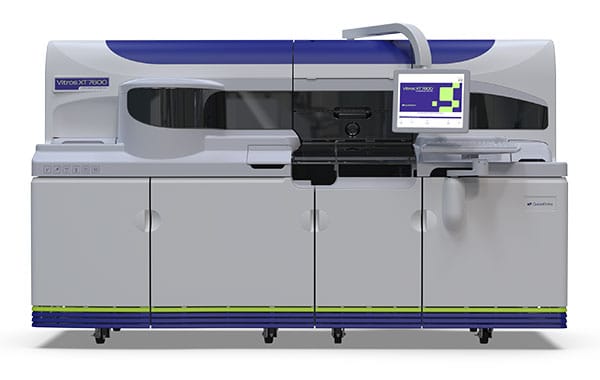
Cystatin C reagent validated for use on the QuidelOrtho VITROS® 5600/XT 7600 Integrated System and VITROS® 4600 Chemistry System
Cystatin C is an emerging renal Biomarker for eGFR and is recommended as part of the KDIGO 2012 guidelines for the early confirmation and diagnosis of Chronic Kidney Disease (CKD).1 In addition to confirming CKD at earlier stages than is possible with serum Creatinine, studies suggest that Cystatin C may help facilitate kidney disease screening efforts in the elderly, and those with diabetes, hypertension, or cardiovascular disease.2-7
Cystatin C
- Uses Avian IgY antibodies which are not interfered with by rheumatoid and HAMA factors for increased reliability
- Traceability to (ERM/DA471/IFCC) the international standard reference material providing increased accuracy and performance
- Fast test results for a rapid turnaround time
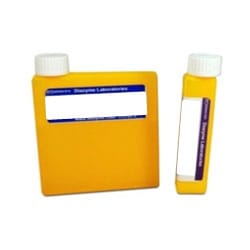
- Formatted liquid reagents ready-to-use, requiring no preparation saving time and reducing sample handling errors
Now validated for use on QuidelOrtho VITROS® 5600/XT 7600 Integrated System and VITROS®4600 Chemistry System

| Please order from QuidelOrtho at www.quidelortho.com | |||
Product | Catalog Number | Packaging | Method/Format |
Kit (172 Tests) | DZ133CKY1 | R1: 1 x 60 mL | Latex Enhanced |
Calibrator | DZ133CCal | 5 x 1 mL | Liquid Stable |
Control | DZ133CCon | 2 x 1 mL | Liquid Stable |

CLIA:
Ortho-Clinical Diagnostics VITROS 4600 Chemistry System {Diazyme Cystatin C Assay} – CLIA Document Number CR180360
Ortho-Clinical Diagnostics VITROS 5600 Chemistry System {Diazyme Cystatin C Assay} – CLIA Document Number CR180360
Ortho-Clinical Diagnostics VITROS XT 7600 Chemistry System {Diazyme Cystatin C Assay} – CLIA Document Number CR190271
For CLIA decision summary, please click here. Search with provided document number above.
Documents are updated periodically and customers should periodically check to confirm they have the latest version of their technical document.

- Kidney International Supplements (2013) 3, 136–150; doi:10.1038/kisup.2012.72; 5-8.
- Filler G, Bökenkamp A, Hofmann W, Le Bricon T, Martinéz-Brú C, Grubb A. Cystatin C as a marker of GFR – history, indications, and future re-search. Clin Biochem 2005; 38: 1-8.
- Dharnidharka VR, Kwon C, Stevens G. Serum cystatin C is superior to serum creatinine as a marker of kidney function: a meta-analysis. Am J Kidney Dis 2002; 40: 221-226.
- Grubb A, Björk J, Bondesson P, Lindström V, Sterner G, Nyman U. Cystatin C estimates glomerular filtration rate better than creatinine clear-ance using the Cockgroft-Gault formula. Scand J Clin Lab Invest 2005; 65: 1-10.
- Thomassen SA, Johannesen IL, Erlandsen EJ, Abrahamsen J, Randers E. Serum cystatin C as a marker of the renal function in patients with spinal cord injury. Spinal Cord 2002; 40: 524-528.
- Christensson AG, Grubb AO, Nilsson JA, Norrgren K, Sterner G, Sundkvist G. Serum Cystatin C advantageous compared with serum creatinine in the detection of mild but not severe diabetic nephropathy. J Intern Med 2004; 256: 510-518.
- Alan H.B. Wu. Tietz Clinical Guide to Laboratory Tests. Fourth Ed. Saunders Elsevier, 11830 Westline Industrial Drive, St. Louis, Missouri 63146. 2006; 328-329.